The History of the House of the Virgin Mary: Discovery, Faith, and Legacy
The full history of the House of the Virgin Mary near Ephesus: its discovery, the vision that led to it, papal visits, and its significance today.
Loading...


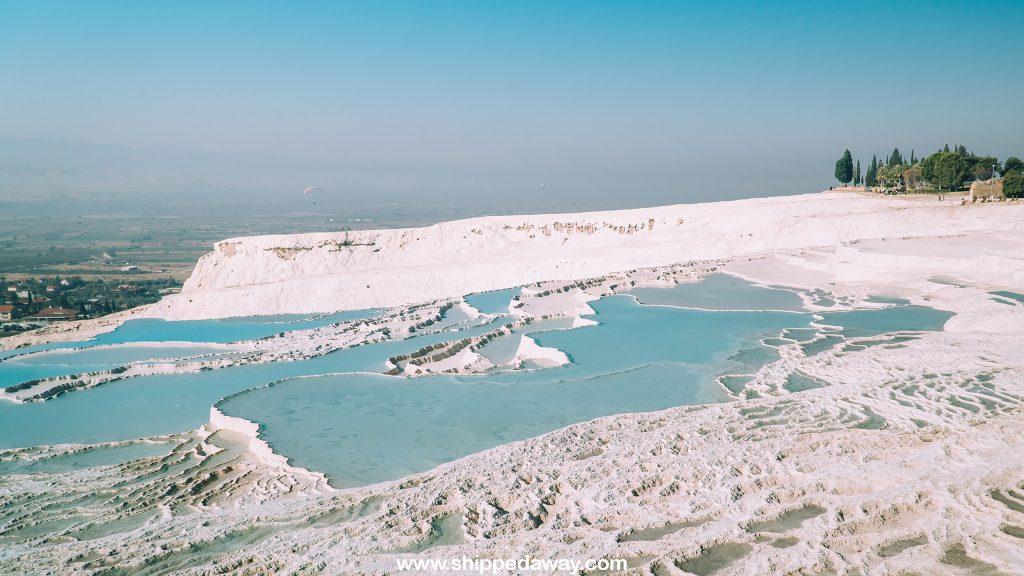
In a country filled with wonders, few places blend nature, history, and serenity quite like Pamukkale, meaning “Cotton Castle” in Turkish.Located in the Denizli Province of southwestern Türkiye, this surreal landscape of white travertine terraces cascading down a hillside looks like something out of a dream.
Table of contents [Show]
In a country filled with wonders, few places blend nature, history, and serenity quite like Pamukkale, meaning “Cotton Castle” in Turkish.
Located in the Denizli Province of southwestern Türkiye, this surreal landscape of white travertine terraces cascading down a hillside looks like something out of a dream.
For centuries, Pamukkale has drawn visitors — from ancient kings and Roman nobles to modern travelers seeking peace and renewal.
Here, mineral-rich waters have sculpted a masterpiece, and time itself seems to move slower, softened by the gentle rhythm of flowing springs.
Pamukkale is not just a destination; it’s a healing experience — a place where the earth itself seems to breathe.
Pamukkale’s striking white terraces are formed by calcium carbonate deposits left behind by hot spring water flowing down the hillside.
As the water cools, it crystallizes, creating the brilliant white formations that resemble frozen waterfalls or clouds turned to stone.
These thermal waters have been flowing for over 14,000 years, maintaining a temperature of around 35°C (95°F).
They’re rich in minerals known to soothe the skin, relax muscles, and promote overall well-being — a natural spa gifted by the earth.
Standing barefoot on the warm white surface, feeling the mineral water flow around your feet, is an experience that borders on spiritual.
Above the travertine terraces lie the ruins of Hierapolis, an ancient Greco-Roman city founded in the 2nd century BC.
It was once a thriving spa town, where citizens came from across the empire to bathe in the healing waters of Pamukkale.
Wander through Hierapolis’ ancient streets, and you’ll find a well-preserved theater, temples, monumental gates, and even a necropolis stretching for kilometers — one of the largest in Anatolia.
The city’s mix of pagan, Hellenistic, and early Christian sites gives it a timeless quality.
The grand Roman theater, seating over 12,000 spectators, still stands proudly against the backdrop of the valley.
Its ornate reliefs and impressive acoustics are reminders of how art and life thrived here centuries ago.
According to Christian tradition, the apostle Philip was martyred in Hierapolis. The Martyrium, built in his honor, remains a place of pilgrimage and reflection — serene, silent, and sacred.
At the heart of Pamukkale lies the Antique Pool, also known as Cleopatra’s Pool — said to have been a gift from Marc Antony to the Egyptian queen.
Imagine swimming among submerged marble columns and ancient stones, with warm, mineral-rich water bubbling around you.
It’s a surreal experience that connects you directly with history — a literal swim through time.
The pool is fed by the same thermal springs that create the travertines, and visitors can still enjoy a rejuvenating dip.
It’s believed that the water helps with circulation, joint pain, and skin conditions — though many will tell you the real healing comes from the peace of the place itself.
The travertine terraces of Pamukkale are the main attraction, and they never look exactly the same twice.
Depending on the light and water flow, their color shifts from pure white to soft blue, golden, or even pink at sunset.
Visitors are required to remove their shoes to protect the delicate formations — a gentle reminder that this beauty is alive, fragile, and sacred.
As you walk along the terraces, you can pause in shallow pools, let the warm water wash over your feet, and feel as if the land itself is welcoming you.
As the sun sets over Pamukkale, the terraces glow with hues of amber and rose, reflecting the fading light in their shallow pools.
It’s a quiet, contemplative moment — one that feels like standing on the edge of heaven.
From the top of the hill, you can see the fertile valley of Denizli stretching below, framed by distant mountains.
It’s easy to understand why the ancients chose this place as a sanctuary of rest and renewal.
While Pamukkale alone is worth the journey, the surrounding region offers even more for curious travelers.
Today, Pamukkale is a protected natural and historical site, attracting visitors from all around the world.
Local residents still live in the nearby village, offering authentic Turkish hospitality, homemade meals, and traditional crafts.
Small boutique hotels and family-run guesthouses provide comfort without compromising the area’s quiet charm.
Evenings are peaceful — you might hear the distant sound of call to prayer blending with the soft rustle of the breeze.
Pamukkale is more than a geological wonder — it’s a symbol of harmony between humans and nature.
Here, ancient civilizations found healing and built sanctuaries; modern travelers find stillness and perspective.
It’s a reminder that beauty doesn’t always roar — sometimes, it flows quietly, shaping the world drop by drop.
Whether you come to soak in its warm waters, explore the ruins of Hierapolis, or simply stand in awe of the Cotton Castle at sunset, you leave changed — softer, calmer, more connected.
In Pamukkale, time seems to pause.
The air carries the warmth of the springs, the ground gleams with light, and the soul feels both grounded and lifted at once.
It is a place that invites you not just to see, but to surrender — to let nature’s quiet power remind you that healing is not a luxury, but a way of being.
Pamukkale isn’t simply visited.
It’s felt — deep in the body, and deeper in the heart.

The full history of the House of the Virgin Mary near Ephesus: its discovery, the vision that led to it, papal visits, and its significance today.
The best Kusadasi tours to Ephesus and the House of the Virgin Mary: tour options, timing, cruise passenger tips, and how to choose the right excursion.
Ephesus & House of the Virgin Mary : openıng hours, best tıme to vısıt, and how to see both sıtes ın one day from kuşadası