The History of the House of the Virgin Mary: Discovery, Faith, and Legacy
The full history of the House of the Virgin Mary near Ephesus: its discovery, the vision that led to it, papal visits, and its significance today.
Loading...


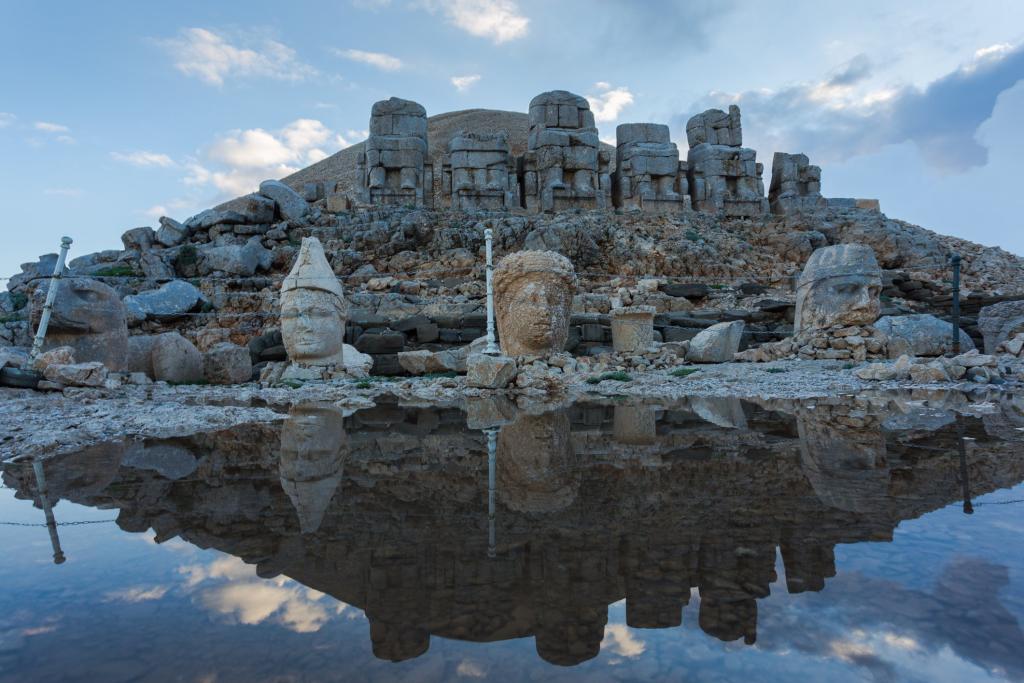
High in the rugged mountains of southeastern Türkiye, where the winds whisper through ancient stones and the sun paints the horizon in gold, stands one of the world’s most mysterious monuments: Mount Nemrut (Nemrut Dağı).
Table of contents [Show]
High in the rugged mountains of southeastern Türkiye, where the winds whisper through ancient stones and the sun paints the horizon in gold, stands one of the world’s most mysterious monuments: Mount Nemrut (Nemrut Dağı).
Rising over 2,100 meters above sea level, this UNESCO World Heritage Site is not just a mountain — it’s a silent stage where gods, kings, and time itself meet.
Here, colossal stone heads gaze eternally at the sunrise, remnants of a forgotten kingdom and the vision of one extraordinary man: King Antiochus I of Commagene.
A visit to Mount Nemrut is more than a journey to a historical site — it’s a pilgrimage into the past, a meeting point of myth, history, and raw natural beauty.
Mount Nemrut was once the ceremonial center of the ancient Kingdom of Commagene, a small but powerful state that flourished between 163 BC and 72 AD.
Strategically located between the Roman and Parthian empires, Commagene was a cultural bridge between East and West — a place where Greek, Persian, and Anatolian traditions merged.
King Antiochus I Theos, a ruler with both royal ambition and divine aspiration, sought to immortalize himself by creating a mountain-top sanctuary that would unite the gods of both worlds.
He declared himself semi-divine and built a tumulus (artificial burial mound) flanked by colossal statues representing both Greek and Persian deities — alongside his own image.
What remains today is not just a tomb, but a message carved in stone: an ancient declaration that human greatness and divine eternity are one and the same.
At the summit of Mount Nemrut, visitors encounter a surreal sight:
Enormous stone heads — some over 2 meters tall — scattered across the terraces, once part of seated statues that stood nearly 9 meters high.
These figures represent Zeus (Ahura Mazda), Apollo (Mithras), Hercules (Artagnes), Tyche (Fortune), and King Antiochus himself.
Each head bears traces of both Greek realism and Persian symbolism, a stunning testament to the cultural fusion Antiochus envisioned.
There are three main terraces:
Standing before these colossal guardians, you can almost hear the echoes of ancient prayers carried by the mountain wind.
The construction of Mount Nemrut’s sanctuary was an engineering marvel.
The tumulus itself — a mound of crushed rock rising 50 meters high and 150 meters in diameter — is believed to cover the tomb of Antiochus, though it has never been excavated.
To this day, the king’s resting place remains undiscovered, adding an air of mystery that only deepens the site’s allure.
What makes Nemrut truly unique is not just its scale, but its philosophy.
Antiochus sought to create harmony between divine forces, cultures, and time — to remind future generations that peace lies in unity.
His vision endures in every fractured statue, in every sunrise that graces the mountain’s peak.
Most visitors begin their ascent in the dark, climbing the steep, rocky path under a star-filled sky.
The air is thin and cool, the anticipation almost tangible.
As the horizon begins to glow, a golden line splits the darkness — and suddenly, light spills across the statues, revealing their timeless faces.
The scene is otherworldly.
No matter how many photos you’ve seen, witnessing the sunrise at Mount Nemrut is a humbling experience.
It’s as if time pauses — for a few moments, you stand between worlds, caught between earth and eternity.
As the light strengthens, you’ll notice the intricate details of each sculpture — the curls of Zeus’s beard, the serene gaze of Tyche, the proud features of Antiochus.
Each one speaks of power, faith, and humanity’s eternal quest for meaning.
Reaching Mount Nemrut is part of the adventure.
The nearest towns, Kahta and Adıyaman, serve as gateways to the site. From there, a winding mountain road climbs through wild, rocky terrain.
Along the way, you’ll encounter other relics of the Commagene Kingdom:
These sites offer context to the grandeur of Nemrut — fragments of a once-proud civilization now reclaimed by nature.
Mount Nemrut was rediscovered in 1881 by a German engineer named Karl Sester, who stumbled upon the ruins while surveying the area.
Since then, countless archaeologists have tried to unlock its secrets.
Despite extensive research, the exact location of Antiochus’s tomb remains hidden beneath the mound — perhaps intentionally so.
Some scholars suggest that the king designed it this way, ensuring that his eternal rest would remain undisturbed, protected by both gods and stone.
The site continues to fascinate historians, not just for its artistic grandeur but for its symbolic message of unity — a concept centuries ahead of its time.
Mount Nemrut is not just an archaeological wonder — it’s a philosophical statement carved in stone.
It reminds us that empires fade, languages die, and mountains crumble, but human aspiration endures.
The desire to reach beyond mortality, to touch the divine, is what makes us human.
Standing there, watching the sun rise behind the colossal heads, you realize that Antiochus’s dream succeeded — not in preserving his body, but in immortalizing his idea.
Few places on Earth capture the soul of history like Mount Nemrut.
It’s a monument not to power, but to vision — a silent hymn to the eternal bond between heaven and earth.
As you descend the mountain, the light softens, and the world below seems distant and ordinary.
But you carry something extraordinary with you — the memory of standing among gods, watching the first light of day fall upon eternity.
In that moment, you understand what Antiochus meant when he built his mountain:
To be remembered not just as a king, but as a dreamer who reached for the heavens.
The full history of the House of the Virgin Mary near Ephesus: its discovery, the vision that led to it, papal visits, and its significance today.
The best Kusadasi tours to Ephesus and the House of the Virgin Mary: tour options, timing, cruise passenger tips, and how to choose the right excursion.
Ephesus & House of the Virgin Mary : openıng hours, best tıme to vısıt, and how to see both sıtes ın one day from kuşadası