The History of the House of the Virgin Mary: Discovery, Faith, and Legacy
The full history of the House of the Virgin Mary near Ephesus: its discovery, the vision that led to it, papal visits, and its significance today.
Loading...


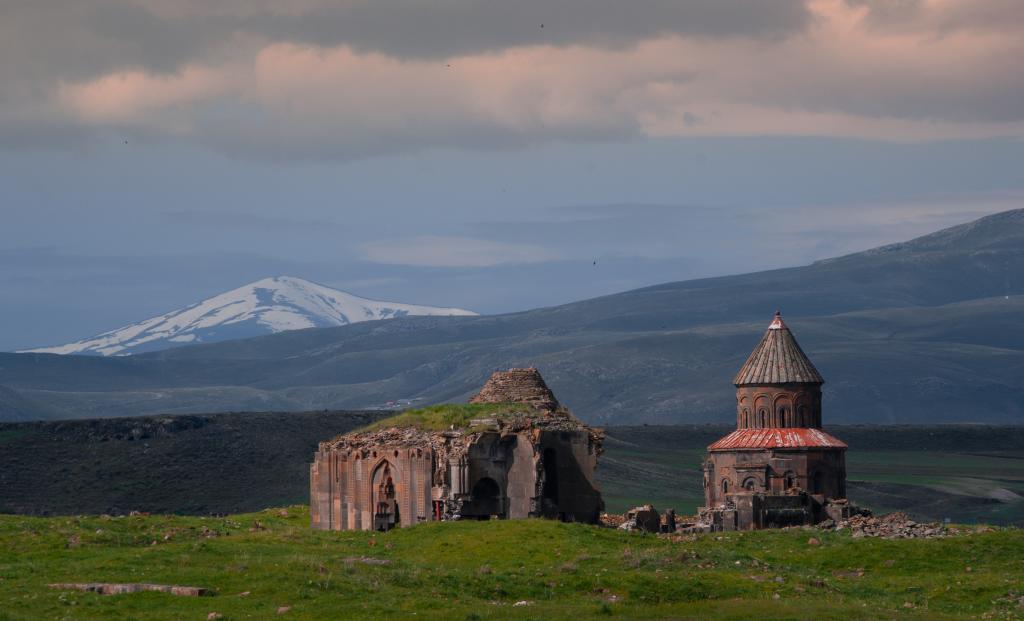
On the windswept plains of eastern Türkiye, near the border with Armenia, lie the haunting remains of a forgotten capital — Ani, once known as the City of a Thousand Churches.
Table of contents [Show]
On the windswept plains of eastern Türkiye, near the border with Armenia, lie the haunting remains of a forgotten capital — Ani, once known as the City of a Thousand Churches.
Today, its broken walls rise above the Akhurian River, silent witnesses to a golden age long gone.
To wander through Ani is to walk among echoes — of prayers once carried by the wind, of bells that no longer ring, of civilizations that left their mark in stone and silence.
This is not just a historical site.
Ani is a sacred landscape, a place where spirituality, architecture, and tragedy intertwine to tell one of the most powerful stories of human endurance.
Founded more than 1,600 years ago, Ani was first mentioned in the 5th century as a fortress belonging to the Armenian Bagratid dynasty.
By the 10th and 11th centuries, it had grown into a thriving capital — a city rivaling Constantinople and Baghdad in wealth and influence.
With a population of nearly 100,000, Ani was known for its golden domes, bustling markets, and majestic churches.
It stood at the crossroads of ancient trade routes, connecting the Byzantine Empire, Persia, and the Arab world — a true meeting point of civilizations.
Its beauty was legendary. Medieval poets called it “the city that shone with 1,001 churches and eternal light.”
But glory rarely lasts forever.
In 1064, the city was captured by the Seljuk Turks, and later suffered from devastating earthquakes and invasions.
By the 14th century, Ani was abandoned — left to the mercy of wind, snow, and time.
Centuries passed, empires rose and fell, and Ani remained — half-ruined, half-remembered — a ghost city of faith and loss.
Yet even in ruin, it retains a power few places on earth can match.
Today, Ani is an open-air museum unlike any other.
Stretching across a vast plateau overlooking the Akhurian Gorge, its ruins reflect a fusion of Armenian, Byzantine, and Islamic architecture, making it a symbol of coexistence and cultural exchange.
Built in 1001 by the architect Trdat, the same genius who helped restore Hagia Sophia’s dome, the Cathedral is Ani’s crown jewel.
Even in partial ruin, its pointed arches and stone carvings reveal astonishing craftsmanship.
Later, during Seljuk rule, it was converted into a mosque — a transformation that tells of Ani’s layered identity, where faiths once overlapped in respect and resilience.
Standing in the quiet interior, you can almost hear the faint murmur of ancient hymns blending with the call to prayer — a harmony of history.
Perched near the cliff edge, this 13th-century masterpiece remains remarkably intact.
Inside, vivid frescoes still adorn the walls — scenes from the life of Christ, painted in deep reds and blues that have survived eight centuries of harsh weather.
When sunlight enters through the small windows, it illuminates the colors like stained glass — a miracle of endurance and faith.
Once one of the grandest churches of Ani, it was split in half by a lightning strike in 1957.
Today, only half remains standing — a dramatic silhouette against the horizon.
Its surviving half feels both tragic and poetic, a perfect symbol of Ani itself: broken but unbowed.
The mighty fortifications that once defended Ani still stand proudly.
Built of volcanic tuff stone in hues of red and orange, the walls stretch for kilometers, punctuated by imposing gates such as the Lion Gate and Kars Gate.
As you walk along them, the wind whistles through the towers, and you can feel the echoes of armies, merchants, and pilgrims who once passed through.
Every stone whispers: we were once alive.
Once connecting Ani to Armenia, only one arch of the ancient bridge remains today, gracefully spanning the river gorge.
It once carried silk and spice caravans — now it carries silence and longing.
Looking across the border, you realize that Ani still stands between worlds — past and present, sacred and forgotten.
What makes Ani extraordinary is not only its history but its spiritual energy.
Whether you are religious or not, there’s something deeply moving about standing alone in a church with no roof, hearing nothing but the sound of the wind.
This is sacredness stripped of grandeur — faith reduced to its essence.
For Armenians, Ani is a symbol of their ancient civilization and Christian heritage.
For Turks, it represents a shared cultural legacy and an early chapter of Anatolia’s multi-faith identity.
For travelers, it’s a reminder that holiness doesn’t depend on religion — it’s born from memory, humility, and silence.
Ani’s architecture was centuries ahead of its time.
It pioneered techniques later seen in Gothic cathedrals — pointed arches, ribbed vaults, and intricate stone facades.
Every building here was a dialogue between earth and heaven, crafted from volcanic stone that glows gold under the afternoon sun.
Patterns and carvings display crosses, stars, and geometric Islamic motifs — a visual conversation between cultures that once shared the same sky.
Ani is located 45 kilometers east of Kars, a city in Türkiye’s far northeast.
By Plane: The nearest airport is Kars Harakani Airport, with daily flights from Istanbul and Ankara.
By Car: From Kars, it’s about a 45-minute drive through highland villages and rolling steppe.
By Tour: Local tours operate from Kars city center and include guides who share Ani’s layered history in both Turkish and English.
The journey itself is mesmerizing — endless plains, grazing sheep, and distant mountains that make you feel you’ve reached the edge of the world.
Ani’s beauty changes with the seasons:
Spring (April–June): Wildflowers cover the ruins; the air is cool and clear.
Autumn (September–October): Golden light and solitude; the best time for photography.
Winter (December–February): Snow transforms Ani into a white dreamscape — haunting and breathtaking, though very cold.
Whatever the season, Ani demands stillness. It’s not a site to rush — it’s one to feel.
Most travelers base themselves in Kars, a small city known for its Russian-era architecture and literary fame (it inspired Orhan Pamuk’s novel Snow).
While here, visit:
Kars Castle, overlooking the city and river.
Fethiye Mosque, another former church converted to a mosque, echoing Ani’s story.
Kars Cheese Market, where you can try local gravyer (Gruyère-style cheese).
Kars complements Ani — both resilient, poetic, and coldly beautiful.
Standing at Ani’s edge, where the land falls into the gorge and Armenia stretches beyond, you realize something profound:
This isn’t just about ruins — it’s about remembrance.
Every broken arch, every fading fresco, every gust of wind reminds us of the impermanence of power and the permanence of beauty.
Ani teaches humility — that civilizations, no matter how mighty, eventually return to dust.
But it also teaches hope — that faith, art, and spirit can outlive centuries of silence.
Ani is not merely a historical site.
It is a pilgrimage through time, a journey into the fragile heart of human creation.
Here, amid crumbling stones and endless skies, you don’t just see history — you feel it.
You feel the prayers carved into the walls, the dreams of builders who believed in eternity, and the silence that still speaks more loudly than words.
To visit Ani is to encounter the sacred in its purest form — a holy city without walls of faith, only horizons of memory.

The full history of the House of the Virgin Mary near Ephesus: its discovery, the vision that led to it, papal visits, and its significance today.
The best Kusadasi tours to Ephesus and the House of the Virgin Mary: tour options, timing, cruise passenger tips, and how to choose the right excursion.
Ephesus & House of the Virgin Mary : openıng hours, best tıme to vısıt, and how to see both sıtes ın one day from kuşadası