The History of the House of the Virgin Mary: Discovery, Faith, and Legacy
The full history of the House of the Virgin Mary near Ephesus: its discovery, the vision that led to it, papal visits, and its significance today.
Loading...


Tucked away in the tranquil hills above the ancient city of Ephesus, near the town of Selçuk in western Turkey, lies one of the most sacred and mysterious places on earth — the House of the Virgin Mary.
Table of contents [Show]
Tucked away in the tranquil hills above the ancient city of Ephesus, near the town of Selçuk in western Turkey, lies one of the most sacred and mysterious places on earth — the House of the Virgin Mary.
For centuries, this humble stone house has been revered as the final home of Mary, the mother of Jesus, drawing millions of pilgrims and visitors from all faiths.
It is a place where silence speaks, where faith transcends religion, and where history meets spiritual serenity.
In a world that often feels restless, the House of the Virgin Mary remains a sanctuary of stillness — a place to reflect, pray, and simply breathe.
The story of the House of the Virgin Mary is woven from both faith and history. According to Christian tradition, after the crucifixion of Jesus, the Apostle John the Evangelist took Mary under his care, fulfilling Jesus’ final wish.
John later traveled to Ephesus to spread the gospel, and it is believed that Mary accompanied him, spending her final years in the quiet safety of these hills.
While her presence in Ephesus was long held as legend, the story gained new credibility in the 19th century thanks to an extraordinary discovery.
In the late 1800s, a German nun named Blessed Anne Catherine Emmerich, who had never visited the region, described detailed visions of Mary’s last dwelling — a small stone house near Ephesus, hidden in the mountains.
Her descriptions were so vivid that a French priest, Father Julien Gouyet, decided to investigate. In 1881, he followed her accounts and discovered the ruins of a small building on Mount Koressos (now known as Bülbül Dağı, or “Nightingale Hill”), matching her visions perfectly.
Further investigations confirmed the structure’s antiquity, and the site was soon recognized by the Catholic Church as a place of pilgrimage.
Today, both the Vatican and the Turkish government preserve the site with great respect — a rare collaboration that mirrors its universal spiritual appeal.
What makes the House of the Virgin Mary truly remarkable is that it transcends religious boundaries.
For Christians, it is a holy site where the Mother of God lived, prayed, and was assumed into heaven.
For Muslims, Mary (known as Meryem Ana) is also deeply revered as the pure mother of the Prophet Isa (Jesus).
Thus, both Christians and Muslims come here side by side — lighting candles, whispering prayers, and seeking blessings.
It is one of those rare places in the world where different faiths unite in shared reverence, proving that devotion needs no division.
Part of what makes this place so moving is its setting. The House of the Virgin Mary is surrounded by pine trees, olive groves, and wildflowers, overlooking the vast Aegean landscape below.
The air feels lighter here — crisp and pure, as if nature itself guards the sacred energy of the site. The gentle sound of leaves rustling in the wind becomes a kind of prayer.
Pilgrims often describe an overwhelming sense of calm upon arriving — a feeling that words cannot quite capture. Whether you come as a believer or simply as a seeker of peace, the serenity of this place touches everyone alike.
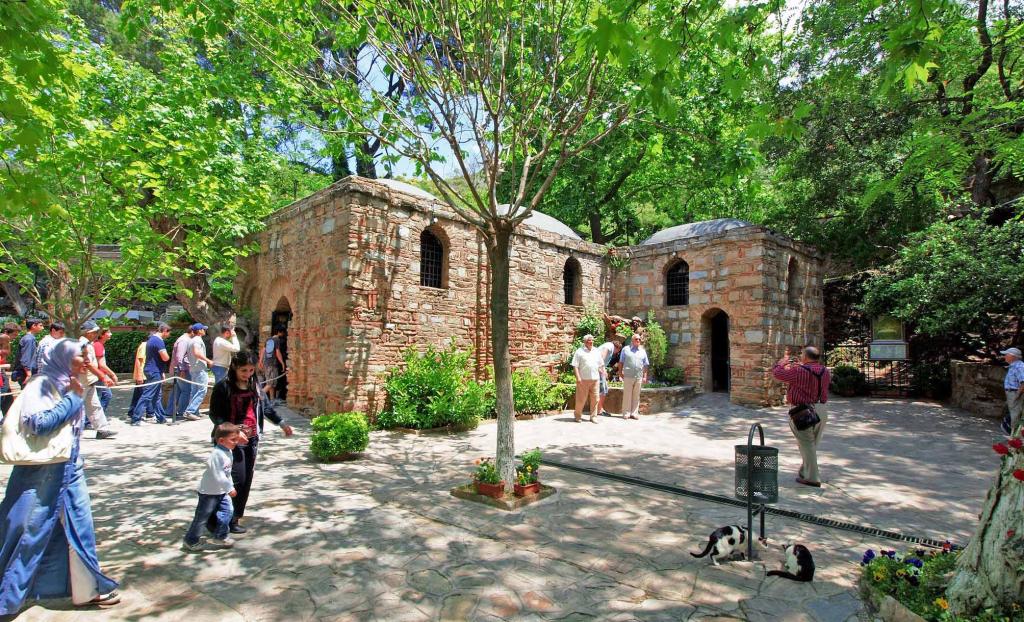
The small stone building that stands today is simple and unassuming, yet profoundly moving. Inside, the House of the Virgin Mary is divided into two parts: a small chapel where visitors can pray and a room believed to have been Mary’s bedroom.
Candles flicker gently along the walls, and the soft scent of incense fills the air. Every visitor, regardless of background, instinctively lowers their voice — the silence here feels sacred.
Masses and prayers are still held regularly, especially on August 15th, the Feast of the Assumption, which marks the day Catholics believe Mary was taken into heaven.
Pope Paul VI visited the site in 1967, followed by Pope John Paul II in 1979 and Pope Benedict XVI in 2006, further affirming its significance as a holy pilgrimage destination.
Just outside the house lies the Wishing Wall, a long stone wall covered in thousands of handwritten prayers and wishes tied with small pieces of paper or cloth.
Visitors write their hopes, dreams, and pleas — for healing, love, forgiveness, or peace — and leave them here with quiet faith.
Nearby, a holy spring flows continuously, believed to have healing properties. Pilgrims often drink from it or take a small bottle home, a symbolic act of purification and renewal.
It’s a simple ritual — yet profoundly emotional, reminding us that faith is not only about belief but also about the act of hope itself.
What makes the House of the Virgin Mary so unique is how effortlessly it blends history, archaeology, and spirituality.
Archaeological studies confirm that the foundations of the house date back to the 1st century AD, consistent with the time Mary is believed to have lived.
Yet, the site’s atmosphere transcends academic analysis. It is not just an artifact of the past — it feels alive, resonating with centuries of prayer and devotion.
Each stone seems to carry a quiet vibration of faith. Even skeptics often admit to feeling a sense of peace they cannot explain.
Visiting the House of the Virgin Mary is not about sightseeing; it’s about experiencing presence.
People from all walks of life come here — some seeking answers, others simply seeking silence. Many light a candle, sit on a bench outside, and watch the sunlight filter through the trees.
The sound of distant church bells, the scent of olive trees, the flutter of birds — together they create a moment of rare stillness.
It’s the kind of peace that feels like prayer, even if no words are spoken.
Location: The House of the Virgin Mary (Meryem Ana Evi) is located on Mount Koressos, about 7 km from Selçuk and 20 minutes from the Ephesus ruins.
Best Time to Visit: Spring (April–June) and autumn (September–October) offer pleasant weather and fewer crowds.
Dress Code: As a religious site, modest clothing is recommended.
Mass Schedule: Sunday masses are open to the public, often conducted in multiple languages.
Entrance: A small entry fee helps maintain the site, and donations are welcome.
Accessibility: The area is well maintained, with shaded paths and seating for those who wish to meditate or rest.
In a modern world full of noise and division, places like the House of the Virgin Mary remind us of what truly matters — faith, unity, and peace.
It doesn’t matter what religion you belong to or what you believe in; what matters is the shared reverence for something greater than ourselves.
This sacred site stands as a living symbol of hope across generations and faiths, offering comfort to the weary and light to the lost.
Here, under the soft Anatolian sun, surrounded by centuries of devotion, you realize something profound: peace doesn’t need miracles — only presence.
The House of the Virgin Mary is not just a destination; it’s a spiritual encounter. It invites you to slow down, to listen, and to feel the quiet pulse of faith that has endured for two thousand years.
Whether you come as a pilgrim, a traveler, or a seeker of peace, you leave with something deeper — a stillness that stays with you long after you’ve gone.
In the end, the magic of this place lies not in its walls, but in what it awakens within you — the timeless truth that faith, in its purest form, is peace.

The full history of the House of the Virgin Mary near Ephesus: its discovery, the vision that led to it, papal visits, and its significance today.
The best Kusadasi tours to Ephesus and the House of the Virgin Mary: tour options, timing, cruise passenger tips, and how to choose the right excursion.
Ephesus & House of the Virgin Mary : openıng hours, best tıme to vısıt, and how to see both sıtes ın one day from kuşadası